
Grant County Court Records After Arrest
Grant County court records after a jail arrest follow a different path than a jail intake entry. The arrest starts with law enforcement. Booking follows at the local detention facility when the person is processed into custody. After that, the Seventh Judicial District Prosecuting Attorney's Office decides what charge or charges to file in court, if any. Once a complaint, information, indictment, citation, or related filing reaches the court, the court record becomes the better source for the formal case.
A booking charge is not the final word. It may reflect the arresting officer's probable-cause label, a warrant description, or an intake code used before review. Grant County court records can later show a changed count, a reduced count, a new case number, a dismissal, a plea, or a trial setting. Custody and booking questions belong with the Grant County jail inmate records path, while booking photos belong with the Grant County jail mugshots path. The court record is the place to read the filed charge and the case status.
Important: Search ARCourts helps locate a filed case after an arrest; it is not a live jail roster or a warrant clearance tool.
Find Grant County Court Records
The main online case channel is Search ARCourts, the Arkansas Judiciary portal for public case information in courts that use the Contexte case management system. The Judiciary explains the service at its Search ARCourts information page. It is replacing Public CourtConnect and can be used when the searcher knows a participant name or a case number. All Arkansas circuit courts provide statistical case information under Administrative Order 8, and some district courts provide case information through the same system.
The most useful first check after a Grant County arrest is the defendant's name. If a citation, notice, bond paper, warrant, or clerk notice has a case number, search by that number too. A case may not appear the same day a person is booked. If the matter has not yet been filed, call the court or clerk that is likely to handle it. Search ARCourts can show parties, judge, filings, charges and dispositions, future events, judgments, and links to some public court documents, but some information is withheld under Arkansas Supreme Court Administrative Order 19.
- Check custody first if the arrest is new, because the Sheridan Detention Center may know whether the person is still held.
- Search ARCourts by participant name, then repeat the search by case number if court paperwork lists one.
- Open the matching case and compare the filed charges with any booking or bond paperwork.
- Confirm court dates, payment options, sealed-record questions, and case-specific details with the filing court.
The Search ARCourts portal screen is the correct statewide starting point for Grant County court records after an arrest.
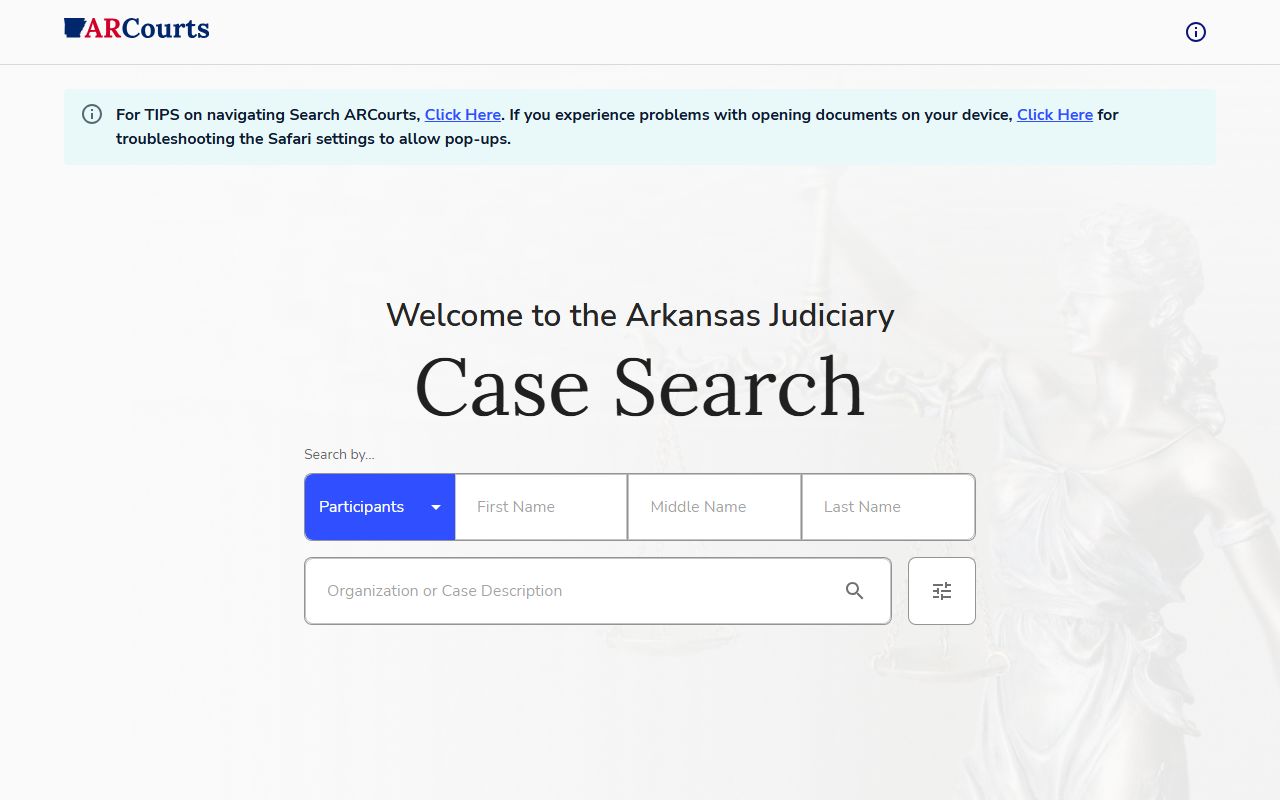
Use the portal for filed cases, not to infer that every booking has already become a court case.
Grant County Case Search Fields
The case-search fields captured from Search ARCourts are limited because the portal is dynamic, but the Judiciary's public description confirms the core paths. Name and case-number searches matter most. Filters may help narrow results when available, though the exact list was not fully captured from the public screen. For Grant County court records after jail arrest, a case-number search is usually the cleanest match when paperwork is available.
| Field Label | Type | Required | Grant County Use |
|---|---|---|---|
| Search by | Tab or menu | Required path choice | Captured text shows Participants as an option. Use it when searching by person name. |
| Participant name | Text | Likely optional by path | Use the defendant's full legal name, and try name variants if no case appears. |
| Case number | Text | Likely optional by path | Use the number from a citation, warrant, clerk notice, bond paper, or court notice. |
| Court or county filters | Dropdown or filter | Not fully captured | Use available filters to narrow Arkansas results to the correct court or county. |
For portal problems, the Arkansas Administrative Office of the Courts lists (501) 410-1900 option 1 and (866) 823-5778. Case-specific questions should go to the court where the case is filed.
Grant County Courts After Arrest
Grant County District Court is a common first stop for misdemeanor, traffic, city, county, and local-ordinance cases after an arrest or citation. The official county page identifies Judge Billy Jack Gibson for the 33rd District Court District. The court is at 101 W Pine St, Room 5, Sheridan, AR 72150, and the listed phone number is (870) 942-3464. The page says the court covers misdemeanors, other state-law and local-ordinance violations, civil contract and property matters under $25,000, and small claims under $5,000.
The District Court schedule gives useful timing clues for court records after a Grant County arrest. County plea and arraignments are listed for the first Tuesday. City plea and arraignments are listed for the second Tuesday. County trials are listed for the third Tuesday, city trials for the fourth Tuesday, and civil and small-claim trials for the second Wednesday. This schedule does not prove a person's next court date. It helps identify which counter to call when a local case has not appeared online yet.
The Grant County Circuit/County Clerk is Geral Harrison at 101 West Center, Room 106, Sheridan, AR 72150. The clerk's phone is (870) 942-2631 and fax is (870) 942-3564. Office hours are Monday through Friday, 8:00 a.m. to 4:30 p.m.; the office is open during the noon hour and closed major holidays. The clerk serves Circuit and Juvenile Courts, maintains proceedings and dockets, keeps pending circuit files and past county cases and dispositions, and cannot give legal advice.
| Local Office | Best Use After Arrest | Key Limit |
|---|---|---|
| Grant County District Court | Misdemeanor, ordinance, traffic, plea, arraignment, trial, and fine questions. | Confirm whether the case is filed there before making payment or travel plans. |
| Grant County Circuit/County Clerk | Circuit case files, dockets, warrants, subpoenas, writs, and older case dispositions. | Clerk staff can give record procedure, not legal advice. |
| Seventh Judicial District Prosecuting Attorney's Office | Formal charging decisions and later amendments to filed criminal charges. | Use cautious office-level routing, since the research did not verify a current official biography page. |
Grant County Arrest Charging Records
The arrest-to-court path is simple in outline but often slow in practice: arrest, booking, first appearance or arraignment, prosecutor review, filed charge, then court events. The charging document is what moves the matter from a custody label into a court case. In Grant County, the prosecutor may file a different charge than the booking label, decline a charge, amend a charge, or proceed with one count while dropping another.
| Document | Who Usually Initiates It | What It Does | Reader Caution |
|---|---|---|---|
| Complaint | Officer or prosecutor | Sets out the alleged offense and can begin a criminal case. | Common in lower-level or early filings, but local practice varies by case. |
| Information | Prosecutor | States the formal criminal charge filed by the prosecuting attorney. | May replace or refine the booking charge after review. |
| Indictment | Grand jury | Charges an offense after grand-jury action. | Less common for routine local matters, but still a charging document type. |
Grant County Charge Status
A court record can change more than once after a jail arrest. Pending means the charge is still open. Amended means the prosecutor or court record now uses changed wording, a changed count, or a changed level. Reduced means the charge has moved to a less severe offense or lesser count. Dismissed means the count is no longer being pursued in that case. Nolle prosequi is a prosecutor's formal decision not to continue a charge at that time.
| Status | What It Means | Where to Verify |
|---|---|---|
| Pending | The charge is filed and still open, with no final disposition shown. | Search ARCourts and the filing court. |
| Amended or reduced | The filed charge changed after prosecutor or court action. | The docket, filings, and clerk's case file. |
| Dismissed | The charge was ended in that case by court action. | The disposition entry and court order, if public. |
| Nolle prosequi | The prosecutor chose not to proceed with the charge at that time. | The docket and final disposition fields. |
| Convicted | The person was found guilty or entered a guilty/no-contest plea accepted by the court. | The judgment, disposition, and any sentence entry. |
Note: Do not treat a Sheridan Detention Center booking label as the final Grant County court charge.
Bond After Grant County Arrest
Sheridan publishes an official bond sheet page that links a Word document with fine or bond amounts for many offenses. The document begins with a note that highlighted entries indicate mandatory court appearance, but the extraction reviewed for the research did not preserve which items were highlighted. For that reason, no amount should be read as a promise of release. The detention center, District Court, or clerk must confirm whether a person is bondable, whether court appearance is required, and what payment method applies.
District Court ticket payments are a separate issue from jail release. The Grant County District Court page lists online payment at myfinepayment.com, phone payment at 1-877-591-8768, and payment-error help at 1-844-591-8768 Monday through Friday from 7:00 a.m. to 7:00 p.m. It also lists in-person payment at Room 5 and mail payment by cashier's check or money order. Personal checks are not accepted for mailed District Court payments.
- Cash bond
- Money paid directly in a form the court or jail accepts to secure release.
- Surety bond
- A bond posted through a licensed bonding company, subject to fee and court rules.
- PR bond
- A release on personal recognizance, based on a promise to appear instead of full cash deposit.
- No-bond hold
- A custody status where payment alone will not release the person.
Grant County Warrants and Arrest
No official Grant County Sheriff active-warrant list was located in the county and city sources reviewed. The official county officials page names Sheriff Pete Roberts, but it does not publish a searchable warrant database. That matters because court records after an arrest may begin with a warrant, while the Circuit/County Clerk page says the clerk issues summons, warrants, subpoenas, and writs authorized by Circuit Court for delivery by the Grant County Sheriff. District Court can also be relevant for misdemeanor, ordinance, traffic, plea, arraignment, and failure-to-appear matters.
Check warrants through the court channel that may have issued the warrant, Search ARCourts when a case number or name is known, and the Sheridan Detention Center if the warrant already led to booking. ARCH should not be used as a warrant search because the official ARCH limits exclude active warrants. Do not assume a warrant can be cleared at a counter without arrest, booking, bond, or a judge's order.
- Arrest warrant: authorizes law enforcement to arrest a person.
- Bench warrant: often issued after failure to appear or a court-order violation.
- Search warrant: authorizes a search, not a jail booking record.
- Fugitive warrant or hold: may involve another county, another state, or a federal agency.
Grant County Charges vs Convictions
An arrest and a charge are not the same as a conviction. A charge is an accusation filed in court. It may be supported by probable cause, a citation, a complaint, an information, an indictment, or a warrant. A conviction comes later, if the person pleads guilty, pleads no contest where accepted, or is found guilty after trial. Court records after a Grant County jail arrest should be read with that time line in mind.
| Point of Comparison | Charge | Conviction |
|---|---|---|
| Stage | Accusation filed or pending in court. | Final finding, plea, or judgment. |
| Proof level | Lower early-stage showing, often tied to probable cause. | Beyond a reasonable doubt or an accepted plea. |
| What may happen | Can be amended, reduced, dismissed, or declined. | Can lead to sentence, fine, probation, jail, or appeal rights. |
| Lookup value | Shows what the prosecutor filed after arrest. | Shows the case outcome, if public and not sealed. |
Sealed Grant County Arrest Records
Arkansas uses sealing language for many post-case record restrictions. Under Ark. Code 16-90-1409, a person may petition a district or circuit court to seal a prior arrest record if the prosecutor has not filed charges within one year of the arrest. Ark. Code 16-90-1413 governs sealing procedure and requires clerks, arresting agencies, and criminal justice agencies to segregate or electronically restrict sealed records unless access is otherwise allowed.
Expunged is often used in public speech to mean cleared or hidden, but Arkansas source material here supports the more precise term sealed. A sealed record is generally restricted from public access. It is not the same as saying the underlying event never happened for every legal purpose. Search ARCourts may also withhold nonpublic information under Administrative Order 19, and juvenile, sealed, medical, security, and ongoing-investigation material may be unavailable.
| Point of Comparison | Sealed | Expunged |
|---|---|---|
| Plain meaning | Restricted from general public access under a court process. | Common public term for cleared records, but not the preferred term in the cited Arkansas sealing statutes. |
| Public search impact | May be withheld from Search ARCourts, ARCH, and agency public responses. | Do not assume destruction unless a law or court order says so. |
| Grant County route | Petition the proper district or circuit court when eligible. | Ask the court or an attorney which Arkansas procedure applies. |
ARCH and Grant County Records
Arkansas Criminal History, often called ARCH, is the official paid statewide criminal-history service. It is useful only for a different question than Search ARCourts. Search ARCourts helps find filed court cases. ARCH returns a state criminal-history result when the required name and identity fields match. The research found a $24 nonrefundable fee, online credit or debit card payment, and required first name, last name, sex, and date of birth.
ARCH results are limited to Arkansas felony and misdemeanor convictions, open Arkansas felony arrests less than three years old, and sex-offender status. ARCH does not include active warrants, unresolved misdemeanor arrests, dismissed charges, sealed records, pardoned convictions, federal records, out-of-state records, traffic citation history, or arrests that were not fingerprinted. The Arkansas Crime Information Center is the state repository behind this type of criminal-history information.
The ARCH page is a statewide background-history service, not the Grant County court docket.
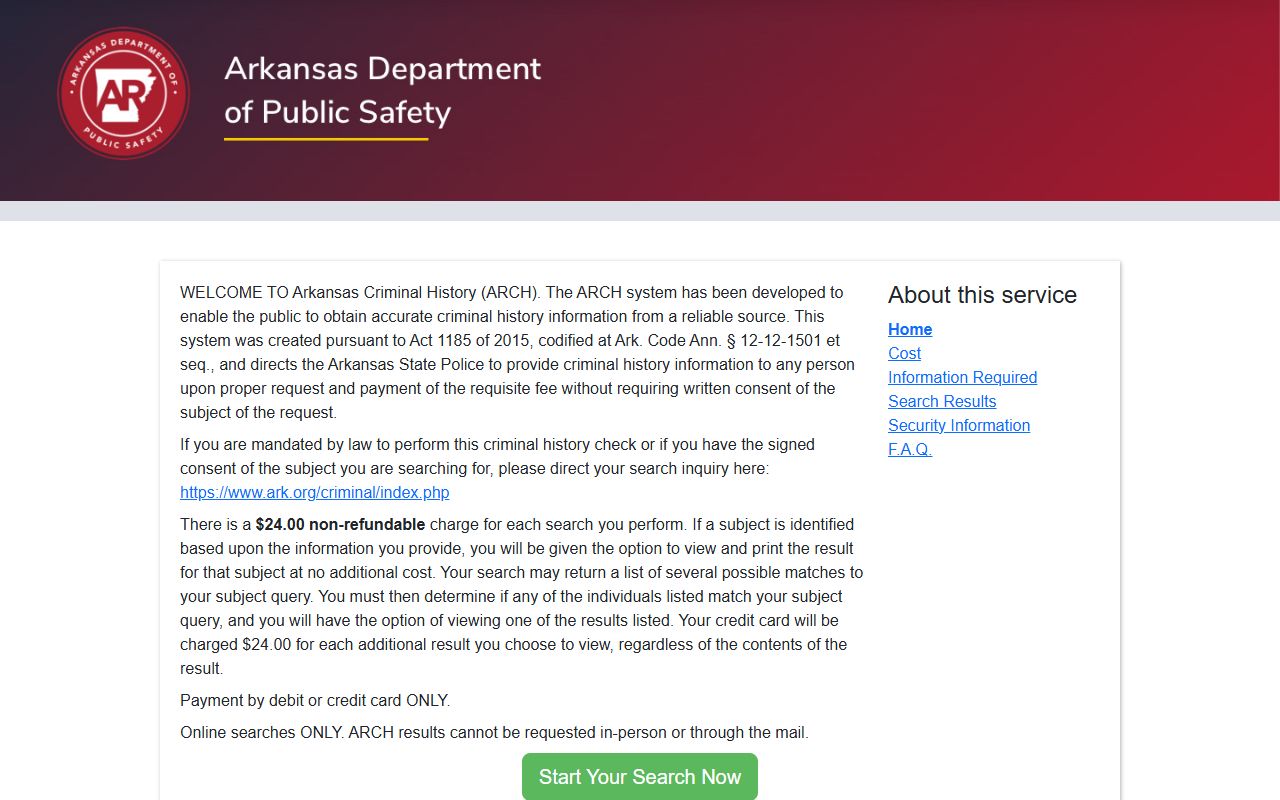
Use ARCH only when a statewide Arkansas criminal-history result is the goal, and use the court or clerk for case-specific records.
Public Access Limits After Arrest
Arkansas FOIA defines public records in Ark. Code 25-19-103 and provides inspection and copying access in Ark. Code 25-19-105, unless a specific exemption applies. Court access is also shaped by court rules, including Administrative Order 19 for nonpublic court information. This is why a Grant County court record may show a docket and charge status while another part of the arrest, such as a juvenile matter or sealed detail, does not appear online.
For a public-records request, identify the record with as much detail as possible: full name, date of birth if known, arrest date, citation number, case number, warrant number, agency, court, and record type. Ask for a docket, charging document, disposition, bond record, warrant record, or court file when the court holds it. Ask the arresting or detention agency for booking material. Keep the request narrow, because broad requests are slower and more likely to miss the exact Grant County arrest record needed.
Important: Court and custody information cannot be used for employment, credit, housing, insurance, tenant screening, or other FCRA-regulated decisions.
Public Record Search
Sponsored Results